

As The Plotter theater criticism online magazine launches in Chicago, a wannabe newspaper baron gets a tad heavy-handed next door
Also, arrests in CBS Chicago attack, a Black oral history project, why a Wednesday newspaper came out on a Tuesday last week, and more

Good morning, readers and subscribers.
The last couple of days sure have thrown curveballs. By July 1, I knew this week’s missive was going to be busy - five, possibly six items worthy of multiple paragraphs - so I would have to make some hard calls about what would be included in this one, and what can wait for another missive. Which was going to be tricky enough. But then, I got sick over the weekend. I am feeling better as I’m putting together this post, but I still haven’t fully recovered.
This is one of those situations where being a one-person shop kind of sucks. I have no one to delegate this to, no one who can finish a post for me. But I also don’t want to delay the post too much further, because then I’d have even more to catch up on. So I did my best to put together the pieces I had, and I’m putting this out with hope that I don’t sound too loopy.
Hopefully, I will feel better by next week. Like I said, there’s a lot of stuff that didn’t make it in that I want to put out. Expect something about Streetsblog Chicago’s not entirely successful fundraiser, how the June 27 Block Club Chicago/BUILD Chicago workforce development event went, a write-up of the results of a journalism contest that I had to delay reporting on because of some fact-checking (you’ll understand what I mean once you read it) and… well, I’m sure something else big and important is going to come up.
In the meantime…
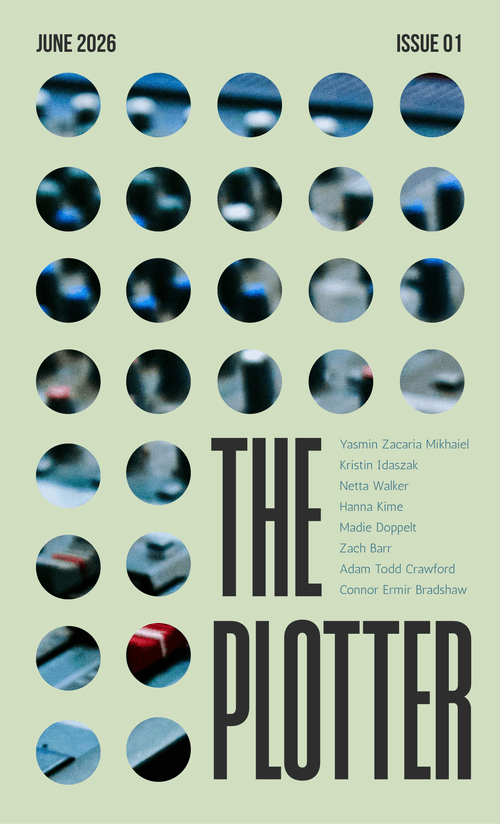
The Plotter online theater criticism magazine launches
Last Monday (June 29) the first issue of the Plotter, the Chicago-based online theater criticism magazine, officially launched.
It is the brainchild of two Chicagoans with plenty of connections in the city’s theater scene - playwright Connor Ermir Bradshaw (who does marketing for a living) and Alan Todd Crawford, “writer, editor, designer, photographer, director, and choreographer” who is alsothe co-owner of the Understudy, the Andersonville-based bookstore and cafe that focuses on plays and play-based works.
Now, the term “online magazine” can encompass anything from an online media outlet that does magazine-style journalism, to something that looks like a physical magazine that just happened to be not printed, to something like what The Plotter did - several articles grouped into an “issue.” There is a cover, but no attempt to emulate the look of a physical magazine. Rather, it emulates the magazine structure, in the sense that it is supposed to be read as a package rather than individual pieces, something that’s meant to capture a moment in time rather than be updated on an ongoing basis.
The co-founders described their mission thusly (emphasis theirs):
This magazine is the brainchild of countless conversations with artists, viewers, and believers of/in the Chicago Theatre Community.
Born from a desire to do better for artists who want to do better, The Plotter seeks to frame criticism not as a negative nor as a make-or-break factor for ticket sales.
Criticism should be the long-term memory of an arts community. It is how we can remember what came from before and engage deeply with what’s in the present. Every review, every production, every installation is a point on a plot. Over time, as credits roll and sets go up and come down, we see more points populate the chart. We see the trend they form.
That is why we launched this magazine: to plot our past so we can chart our future.
I didn’t have time to delve into it as deeply into the articles as I like, but from what I saw, the Plotter’s mix of essays, criticism and interviews looks promising. And I definitely think there is room for something like this. The daily and weekly papers don’t do nearly much theater criticism as they used to, especially these kinds of essays and deep dives.
The magazine makes it clear (if you scroll down a bit) that they’re not paying their writers with money. Rather, they use what they call “barter system,” which is described as “services, favors, access, or introductions roughly commensurate with the rates an indie mag would otherwise offer.” Which, if you keep reading, means they will offer the writer something, the writer will decides if that’s a worthy compensation, and, if not, they try again until they hopefully find something that works for both parties, if they can. (There is language about them making “good-faith attempts to match the exchange to something you actually want.)
There is also a bit about how “all donated funds are allocated to the contributor base,” and those funds will be shared with the public. But this does raise the questions on how the funds will be split - in equal portions, in portions based on the value of their articles in terms of time spent and research required, or some arbitrary measure the editors make up.
If that seems harsh - I’m a freelancer, readers and subscribers. Trying to figure out how a contract can screw me over is a big part of a freelancer’s job.
In fairness, they are hardly the only publication in Chicago area that doesn’t pay writers actual money. The Pub print-only quarterly newspaper immediately comes to mind, as does Streetwise. So long as they are up front about what the contributors are getting into, people can make their own choices. But it does mean that, until the money starts coming in, The Plotter will succeed or fail based on the contributors’ willingness to give their time and effort.
Will this be enough? I suppose, for now, we’ll just have to wait and see.
Aspiring newspaper baron forces clumsy puff piece on his newspapers
I’ve written a few times about David Hoffmann, the current majority owner of Lee Enterprises newspaper company, who separately owns Hoffmann Media newspaper group, along with a whole bunch of other companies. In the greater Chicagoland, Lee owns The Times of Northwest Indiana and Kenosha News, and it owns a bunch of newspapers elsewhere in Illinois and Wisconsin (and quite a bit beyond).
Now, back in the early 20th Century, newspaper magnates shamelessly using their properties to advance their agendas was common. But today, in a very different industry, Lee executives ordering the papers to run a flattering profile of Hoffmann on the front pages of July 4-5 issues, out of all weekends, is pretty unusual and, to put it mildly, pretty dang heavy-handed.
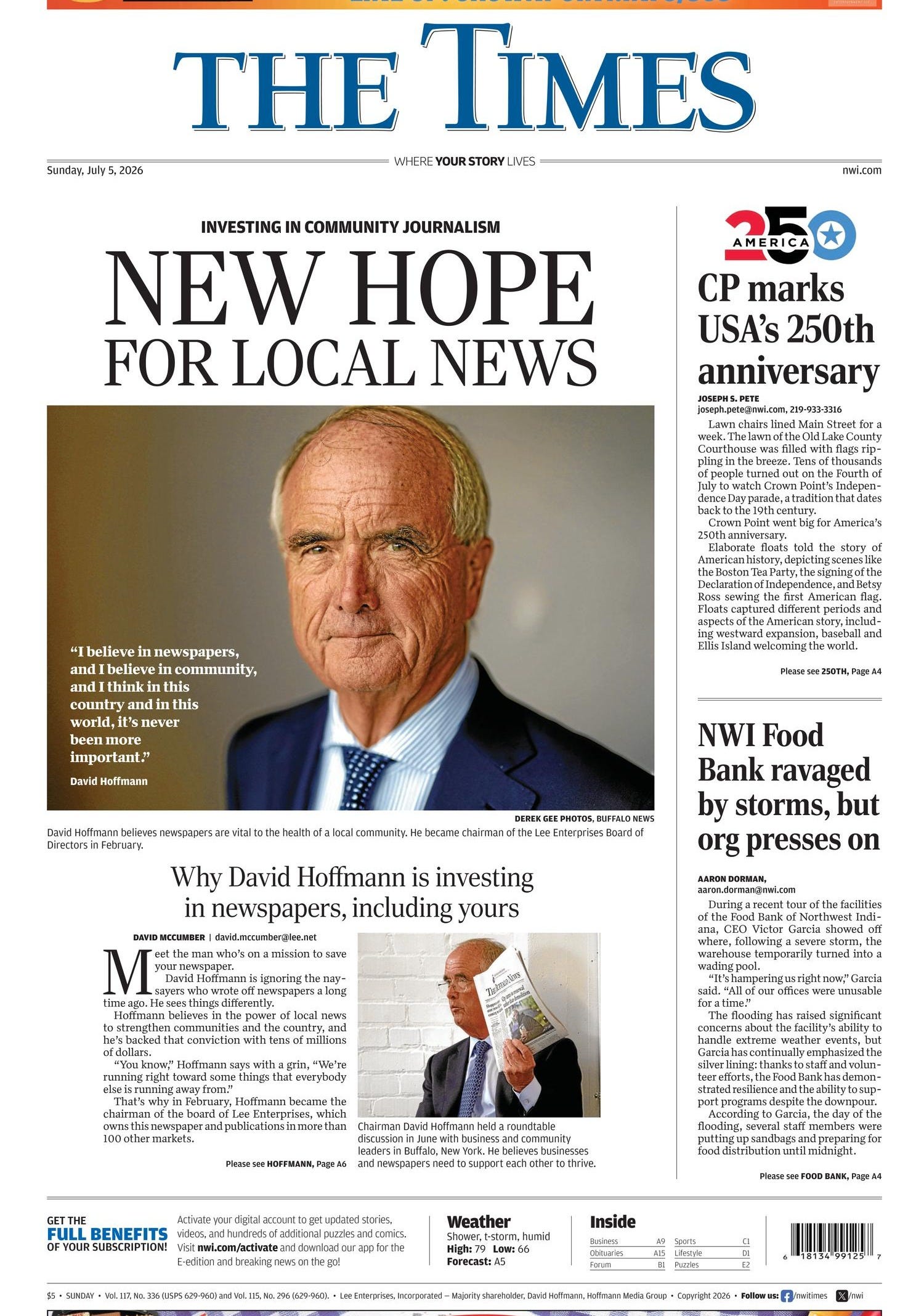
Running a profile of a majority owner would raise eyebrows even if it did it best to be objective, disclosed all of the conflicts of interest and fact-checked everything. But this, readers and subscribers, is not really trying to be objective. Here is a sample (emphasis mine):
It’s funny, the events that change a life.
When he was just 9 years old, Hoffmann pitched a no-hitter for his Little League team. The life-changing moment, though, came afterward.
The local newspaper, the Missourian, wrote a story about the no-hitter and ran it with Hoffmann’s picture.
The Missourian newspaper in Washington, Missouri, ran a story about David Hoffmann’s no-hitter when Hoffmann was 9 years old. The experience stuck with him, and now Hoffmann is chairman of the board of Lee Enterprises.
“That made a huge impact on me,” Hoffmann says. “It piqued my interest in the newspaper, and I started reading it.”
He never stopped.
But what really struck me was that the article repeated an error that appeared in a similarly flattering Forbes magazine profile. As you may recall, that article talked about how the shutdown of the Pioneer Press newspapers (specifically its Glenview newspaper) inspired Hoffmann to get into the newspaper business. We know, of course, that Pioneer Press is still around - but we also know that 22nd Century Media, which also had a Glenview newspaper, did shut down during the pandemic. Occam’s Razor suggests Hoffmann mixed up the newspaper chains, and everybody just took him at his word.
Since then, theree were plenty of opportunities to get it right and avoid repeating that mistake in the future, yet her it is again in the advertorial (emphasis still mine):
Five years ago, Hoffmann wanted to read about the athletic exploits of his grandchildren in the Chicago area. Unfortunately, that type of local sports coverage wasn’t as plentiful as he had expected, Hoffmann remembers. He found out that the Pioneer Press in Glenview, one of Chicago’s northern suburbs, had recently closed up shop.
“It made me realize what that meant for many small communities across America,” he says. “The newspaper builds the fabric of a community, celebrates it. What’s going to take the place of that?”
This is a ridiculously easy thing to fact check. The fact that nobody did, and this was allowed to go to print in multiple newspapers across multiple states… If I was working for any of the Lee newspapers, I would be mortified.
Poynter, which broke the story, quotes Mark Plemmons, an editor at the Independent Tribune in Concord, North Carolina, framed the editorial as a the way to give the markets the papers serve some confidence in their long-term future.
““The biggest thing I fight in my market is people thinking we are going out of business or have gone out,” he was quoted as saying. “This should give our readers more confidence.”
Hoffmann is hardly the first millionaire who seemed to genuinely believe in newspapers and feel that he knew the secret sauce for how to fix the industry’s woes. The only thing that’s different is the sheer scale of his ambitions and how many papers he managed to control. But the fact that Lee Enterprises carries debt from buying Berkshire Hathaway newspapers is a reminder of how easy things can go sour.
Nice words about long-term commitment don’t give confidence, especially when delivered in such heavy-handed way, with at least one factual error allowed to slip through. Actions - like, say, willingness to invest in the paper by investing in its employees - do.
Chicago Media Journal has been brought to you by….

And readers and subscribers like you.
Journalism Bits and Bites
Three men are facing multiple criminal charges after attacking a CBS2 Chicago crew near Adler Planetarium on June 29. Jon Twist, 37, was charged with one felony count of a hate crime, one felony count of criminal damage to property, and one misdemeanor count of resisting an officer. William Huerta, 41, was charged with one felony count of fleeing and attempting to elude officers, two misdemeanor counts of aggravated assault of a state of Illinois employee, one misdemeanor count of reckless driving, and leaving the scene of a crime. Rafael Salinas, 29, was charged with one felony count of aggravated battery to a peace officer, one felony count of criminal damage between $10,000 and $100,000, as well misdemeanor charges of reckless conduct and resisting police. We still have no idea what motivated the attack in the first place.
Gov. J.B. Pritzker signed a the bill last week aimed at protecting the editorial independence of public radio and TV stations affiliated with the state’s colleges and universities. The law will take effect at the start of next year.
The Capital B, which has a Gary, Indiana bureau, has launched a Black oral history archival project. The project contains “100 firsthand stories from Black Americans across regions, generations, and identities” the reporters across its bureaus and partners collected last year - and it is still open for further contributions.
Harvey World Herald, a digital news outlet covering Harvey, Illinois, will hold a digital skill and journalism summer enrichment camp for Harvey youth aged 14 to 18. The outlet is responding to Harvey youth complaining about the lack of opportunities, and a feeling that they’re not being heard. The goal is to make the youth more civically engaged (and, while it goes unsaid, it’s not a bad way to develop local talent who could go on to before future stringers/staff reporters).
Chicago Reader social media manager Katrina Pham received the Asian American Journalists Association-Medill Innovator Award for what she did at her previous job as the Audience Engagement Reporter at Borderless Magazine.
"I'm so honored to receive this recognition that represents the intersection of two institutions central to my journalism career: Medill and AAJA," she was quoted as saying. "More and more people are getting their news on digital platforms, and as storytellers and torchbearers of truth, journalists should feel responsible for meeting people where they are on social."
One of the consequences of Chicago Reader once again being part of a chain is that it gave designers an opportunity to create a triptych out of the covers of June issues of the Reader, The Stranger (of Seattle) and Portland Mercury. I am curious if someone out there goes through the trouble of getting all three issues together (I know I would if money wasn’t an object and time wasn’t an issue).
Last week saw Mount Prospect & Prospect Heights Journal, a weekly newspaper published by Journal & Topics Newspapers that normally come out on Wednesday, come out on a Tuesday, for reasons that are entirely bureaucratic. The Village of Mount Prospect Treasurer’s Report is legally required to be published in a newspaper by the end of June, and something went awry when it was published in the previous week’s issue, so they had to republish it ASAP before deadline.
Journalism opportunities
The Association of Heath Care Journalists/Center for Excellence in Healthcare Journalism is seeking a full-time journalist-in-residence “to serve as both a working reporter and a trusted editorial coach for health journalists nationwide.” This being a residency, the position will last for a one year (until about July 2027). Candidate with at least 10 years of journalism experience and “significant experience covering health, health policy, public health or science” preferred. The position pays $80,000 a year, plus a fully AHCJ-paid health plan and other benefits. Oh, and it’s fully remote.
Journalism Events
On Thursday, July 9, Oyez Review, Roosevelt University’s literary magazine, will have a release party for its latest issue at The Pub’s office/community space, 2015 W. Armitage Ave., at 7 ap.m.
On Saturday, July 11, New Lines Magazines political editor Danny Postel will moderate a panel discussion called, straight to the point, “Why the World Ignores Genocide in Sudan.” Panelists include Samir Abdul, Darfur genocide survivor, stand-up comedian and Artist-in-Residence at Northwestern University, Loyola University associate professor of African history Kim Searcy, and Ragaa Abdallah, Sudan native and a Chair and Distinguished Professor of the Computer Technologies and Information Systems Department at Oakton Community College. The panel is part of Juxtapositions: Conversations on Art, Ideas and Global Cross-Currents, a series co-organized by the New Lines Magazine and Nighthawk bar, 4744 N. Kimball Ave., which hosts the event. The panel will take place at 3 p.m., and it’s free and open to the public
Next Wednesday, July 15, Chrystalis, “a literary magazine by trans youth, for trans youth, created with a little help from trans adults” will have a launch party for its second-ever issue at Pilsen Community Books, 1531 W. 18th St,, at 6 p.m. to 8 p.m.
Journalism Jobs
Chicago Sun-Times is hiring a White Sox beat reporter. Pay is $61,953.84 to $72,153.12 per year, as well as “night differential pay of 10 percent of your base salary.” Apply here.
Bloomberg News is hiring the Chicago Bureau Chief, to lead the news service’s Chicago bureau. Must have “significant experience leading journalists and newsroom teams” and “exceptional news judgment and editing skills.” Salary range is $150,000 to $205,000 a year, plus benefits. Apply here.
The Woodstock Independent (yes, that one) is hiring a part-time graphic designer to do newspaper layout and ad design. It’ also looking for (paid) stringers to do some local coverage. To apply, email publisher Rebecca McDaniel.
CAN-TV is hiring a production manager. Must have a Bachelor’s Degree and/or 3–5 years of experience in television, video production, or media operations. Salary is $65,000 a year, plus benefits. Apply here.
The Times of Northwest Indiana is hiring a public safety reporter, mostly focusing on breaking news crime reporting and courts reporting. Pay is hourly, but they don’t specify the rate. Apply here.
The Times of Northwest Indiana is also hiring a sports reporter to cover high school sports in the region’s Lake, Porter and La Porte countries. The pay is also hourly, and the application doesn’t elaborate on the rate, either. Apply here.
Ad Age magazine is hiring a digital editor. Must have at least three years of editor experience. The salary range is $70,000 to $80,000 a year. Candidates who live in Chicago and New York City area preferred. Apply here.