

NEWSWELL Chicago's future, the implications of the Daily Herald sale and how Block Club's news coverage inspires its events
Also, more investment in Vocalo radio, promising news on court transparency, a new Chicago Sun-Times Cubs beat reporter, departures and retirements, award wins, events and freelance opportunities

Good morning, readers and subscribers.
This is another one of those weeks where I had to make some hard choices about what to cut, what to move to a future missive and what to move to a future missive again. Substack length limits can be harsh, but there is also something to be said about keeping these at something resembling manageable length. It is, in a way, like putting together a newspaper. You need to weigh how much space you have, what you can afford to cut or hold back, and what needs to be included, even if you have to get creative with formatting.
If you are a paid subscriber, you have some inkling of what got moved, what got expanded into separate features, and generally what’s coming down the pipeline. Remember that every paid subscription and one-time or recurring donation gets me closer to making Chicago Media Journal more of a regular gig, which will mean more posts per week and fewer hard choices.
One thing that ended up moving to this post that I wanted to make sure to include here was a new Freelance Opportunities section. This will be a recurring section that will talk about time-sensitive calls for submission and more evergreen opportunities. So keep reading toward the end - and let me know what you think of my choices. Could some of this stuff have waited until next Monday? Let me know.
How Block Club Chicago’s new event series builds on major issues its reporters cover
Back in April, Block Club Chicago announced that it will host a West Side workforce development fair at the end of June. The announcement promised something more than a career fair, with free resume reviews, mock interviews, professional headshot and a closet worth of free “work-ready clothing.” There is also going to be access to financial coaching and literary resources, and “speed networking sessions” where “small local businesses and/or hiring employers to connect with job seekers.” There is also going to be a panel led by Block Club’s West Side beat reporter Michael Liptrot about the realities and challenges of finding work and workforce development in the community.
According to Christine Schmidt, Block Club’s Partnerships Associate, this isn’t something Block Club is doing by itself. It got quite a few West Side nonprofits on board, and philanthropic sponsors to help foot the bill. Broader Urban Involvement and Leadership Development (BUILD) Chicago is not only working with Block Club Chicago on the event, but hosting it at its new-ish Austin headquarters.
I decided to look a little deeper into it for two reasons. I wondered why Block Club was going through all this trouble, and how an event like this fit into its news and outreach strategy. But there was also personal interest. I covered the West Side for Austin Weekly News, first as freelancer, than as a staff writer, between July 2015 and mid-January 2024, and I started writing for the paper again as a freelancer in January. Covering the West Side communities, it doesn’t take that long to realize that workforce development is a major, complex, multifaceted issue. It isn’t just about people wanting to work but not being sure where to start, or how to translate their skills into something they can put on a resume. It’s about the perennial question about whether a promising project or initiative will translate into job opportunities for the locals. It’s about West Side business owners wanting to hire local but sometimes struggling to find local employees. And there is the oft-understated issue that there are multiple organizations working on workforce development, but it isn’t always clear from a person on the street who does what, and how to reach them. And while the various organizations have gotten better at coordination and collaboration, there are gaps.
(Like I said - I’ve written a lot about this. This is my best attempt at a broad overview, but there is so much more to say)
Schmidt explained that this event is part of a larger series of events Block Club is doing this year, and (they hope) beyond. The idea is basically to take a major issue its reporters covered, an issue that they knew had resonance in the community, and build an event around that.
“This workforce event is one of the four events that are really meant to be major community engagement spaces,” Schmidt said.
Schmidt said that Maple Walker Lloyd, Block Club’s Vice President of Partnerships, came up with the idea - she just helped develop it. She also noted that this wasn’t entirely uncharted territory for Block Club. Walker Lloyd planned to do monthly neighborhood resource fairs throughout 2020, but the pandemic scuttled those plans.
The first event was The Impact of Immigration: A Night of Storytelling in Little Village, which was held on Jan. 20 at the iconic Apollo’s 2000 Theater. It featured a panel discussion led by Block Club lead immigration reporter and Southwest Side beat reporter Francia Garcia Hernandez, and they worked with the Illinois Hispanic Chamber of Commerce to set up a market with local vendors. The date, Schmidt said, was deliberately chosen because it was the anniversary of the start of Donald Trump’s second term.
'“We knew that folks had so many questions, and we wanted to be in the community with each other to discuss what’s happening in this sort of post-Operation Midway Blitz moment,” she said.
The event was well-received, Schmidt said, and drove home that “there was a need for more community conversations about the issues that were so prevalent in these neighborhoods. and, as you know, Block Club is all about neighborhoods.”
Together We Build: West Side Workforce Development and Career Fair, she said, built on Liptrot’s reporting on workforce development issues, and what he heard from the community about the lack of opportunities.
“We heard from so many, Michael Liptrot heard from so many, that there is a need, that they want to learn about the resources that are out there,” Schmidt said. “We wanted to break down the silos in workforce development space and be a convener.”
She said that, this year, Block Club plans to do two more events. The third event will be what has become a Block Club tradition - a community block party. The fourth, Schmidt said, is going to be on the South Side and build on the health and wellness reporting by Englewood/Auburn Gresham/Chatham reporter Atavia Reed, Bronzeville/Near South Side reporter Jamie Nesbitt Golden and Hyde Park/Woodlawn/South Shore reporter Maxwell Evans. A lot of the details are still TBD, but they know that they want to work with neighborhood organizations and hold it in neighborhood venues.
To get back to our original question - why would Block Club do something like this - doing something that benefits the readers is well and good, but, the way I see it, there are also some pragmatic benefits. Events that go over well create good PR for Block Club, build relationships with businesses and organizations that can pay off on both editorial and advertising side, and help increase the number of readers and subscribers. And, as any reporter knows, events like this can sometimes lead to connections and generate story ideas.
Together We Build will be held on June 27 at BUILD Chicago campus, 5100 W. Harrison St., at 10 a.m. to 5 p.m. Advance registration is encouraged (especially if you are actually planning to take advantage of workforce development services they’re offering)
Upcoming event promises an update on NEWSWELL Chicago newspapers’ future
Since NEWSWELL acquired the four Growing Community Media newspapers (Austin Weekly News, Forest Park Review, Riverside-Brookfield Landmark and Wednesday Journal), things have mostly continued as usual. Sure, things happened behind the scenes, but, aside from the decision to end unsigned editorials, it wasn’t really anything that impacted the readers.
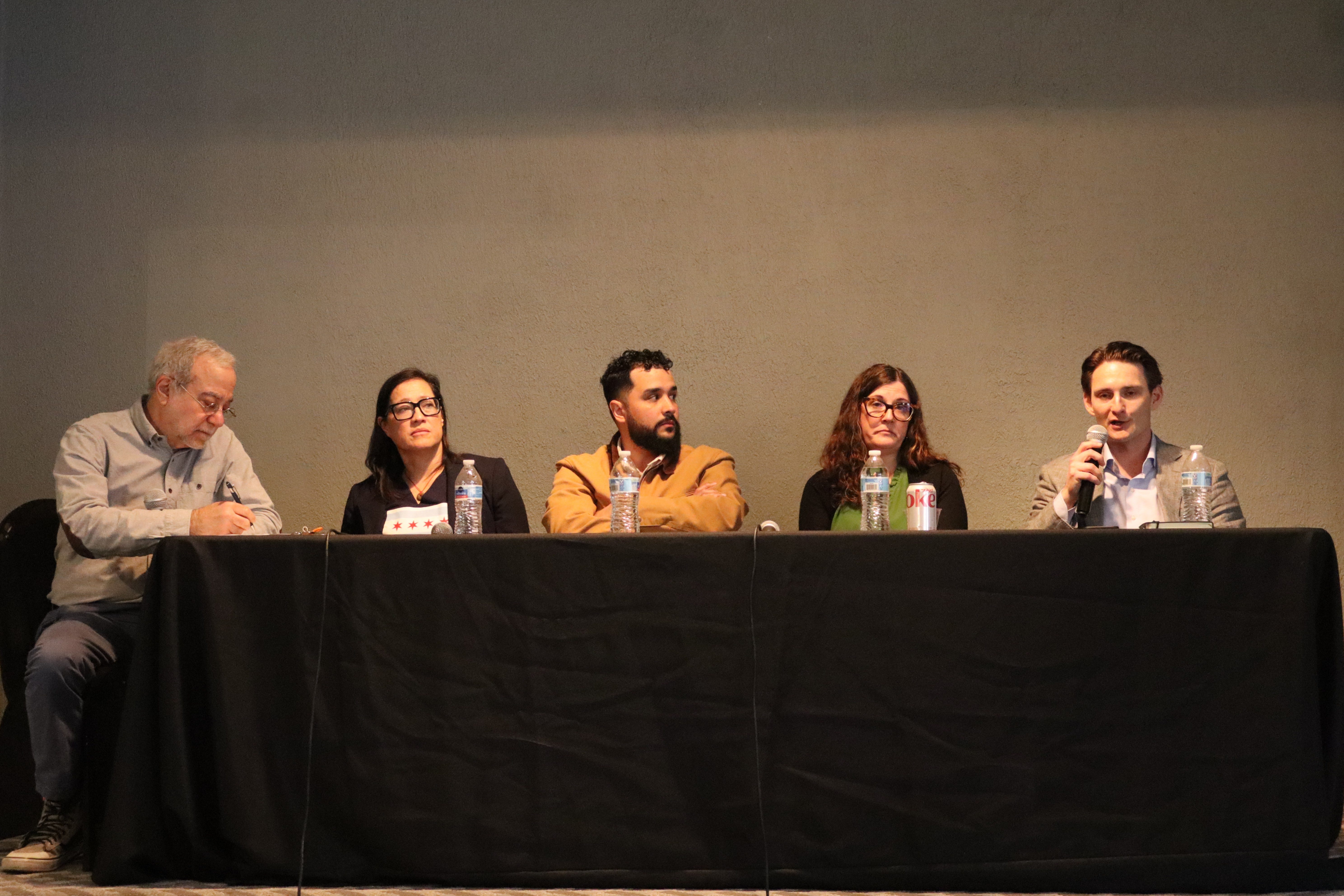
Next Wednesday, June 10, NEWSWELL Chicago will hold a town hall meeting on the publications’ future. The house ad that ran in all four papers described it thusly:
Join NEWSWELL Chicago leadership and community members for an open conversation about the future of local news, the opportunities ahead, and why we believe this moment positions our publications for long-term growth and stability while keeping strong, independent community journalism at the center of everything we do.
In a message to newsletter subscribers, NEWSWELL Chicago General Manager Max Reinsdorf promised that the staff will “share updates, answer questions, and most importantly, hear directly from the community we serve every day.”
The town hall will be held at Oak Park Public Library main library, 834 Lake St., in the Veterans Room meeting room (on the second floor, to the right of the elevators) at 7 p.m.
The potential implications of the Daily Herald sale to Tribune
It has been more than a week since we learned that Paddock Publications tentatively approved the sale of the Daily Herald to Chicago Tribune Media Group. We’ve gotten some updates since then.
Crain’s Chicago Business has reported that Alden offered to pay $24 million to buy Daily Herald. For a bit of context, that’s about 4% of $630 million the investment fund paid to buy Tribune Publishing. Crain’s also reported that Shaw Media’s offer, which started the chain of events that led Tribune to put in its own offer, was “in the ballpark of what Alden-backed Tribune is paying.”
One interesting bit of news that went under the radar is that Shaw sold all of its Iowa newspapers back in late April in order to “sharpen its strategic focus on its core Illinois markets.”
Crain’s reported that Tribune will offer jobs to all current Daily Herald employees, though, as it flagged, it doesn’t guarantee anything after the end of 2026.
“The Tribune has committed to maintain compensation and benefits that are consistent with those provided by Paddock through Dec. 31, 2026,” the memo [to Daily Herald employees] said. “Neither the trustee nor Paddock is making any representation or guarantee regarding continued employment. The Tribune will provide severance benefits to individuals who lose their employment.”
The article cited a separate Tribune memo to Daily Herald employees touting its “commitment to publishing and investing in the print edition well into the future.” Which sounds hollow given, well, the entire history of Alden’s lack of investment so far (and “well into the future” is pretty vague).
Since the tentative deal was announced, there has been discussion of what it would mean for CTMG suburban newspapers those coverage area overlaps with the Daily Herald. - especially the daily Aurora Beacon-News, Elgin Courier-News and (to the lesser extent) Lake County News-Sun. Ditto and Naperville Sun, which currently publishes three days a week. One plausible scenario is that Daily Herald would focus on suburbs where Tribune either has Pioneer Press weeklies or no newspapers at all - but I can also see it close other dailies down. After all, “commitment to publishing and investing in the print edition” doesn’t extend to them, and Alden has closed newspapers before (just not in the Chicago area, at least so far).

The sale wouldn’t quite give Alden the monopoly over daily newspapers in the Chicagoland six-county region - Shaw Media’s Joliet Herald-News, Kane County Chronicle and Northwest Herald would still be around - but it would be a lot closer to that. It would definitely get the bigger market share, which would affect how much it would be able to charge for ads, especially legal ads.
Something I haven’t seen discussed is the sale’s implication for Daily Herald content-sharing agreements. After what was then Sun-Times Media sold its suburban papers to Tribune, it entered into a content-sharing arrangement that allowed it to use Daily Herald’s suburban coverage. Would a sale to its competitor lead to the end of the arrangement? If so, what, if anything, Chicago Public Media would do to fill the resulting suburban coverage void?
Same question about the content sharing with Shaw Media. I think ending the deal would hurt both sides less, but it is something to consider.
And what about what would remain of Paddock? If the sale goes through, how would it use the $24 million? Would any of it go to Southern Illinois Local Media Group and however many newspapers it has (I still haven’t been able to find the current list. We know it was 22 weekly newspapers as of 2023, and at least one of them closed since then)
Bear in mind that we have no idea how much money Paddock is losing - and I do think it’s losing some, because I can’t imagine they would entertain Shaw’s offer if they weren’t. For all we know, all that money would go into plugging a financial hole.
Which brings us to the still important question of what happens if employee-owners reject the sale. What would that mean for Paddock?
I suppose all we can do for now is wait - and hope for more leaks.
Chicago Media Journal has been brought to you by….

And readers and subscribers like you.
Journalism Bits and Bites
Chicago Public Media launched the new Vocalo Hotline show on Vocalo radio last Friday (May 29). As the press release tacitly acknowledged (without putting it into words), the radio station bore the brunt of the Spring 2024 cuts. CPM is describing this as “part of a broader investment in Vocalo’s future, supported in part by a grant from the John D. and Catherine T. MacArthur Foundation.”
Better Government Association announced that the Illinois Supreme Court approved the package of judicial transparency it advocated for. The details are at the link, but it should make getting court information easier for journalists.
Sports journalist Vinnie Duber has been hired as Chicago Sun-Times’ new Cubs beat reporter. He previously served as the White Sox beat reporter, first for NBC5, then for CHGO Sports. I will let more sports-savy people to make the jokes here.
Lizzie Kane, who has been a housing reporting stringer for Chicago Sun-Times since September 2025, announced that she’s been hired as an architecture reporter for the Sacramento Bee. Before her stint at Sun-Times, she was a real estate reporter for the Chicago Tribune. In her farewell post, Kane expressed appreciation for her colleagues at the Trib and the Sun-Times, as well as Chicago’s “housing community.”
“When I moved to Chicago, I’d barely spent any time in the city and knew few people,” she wrote. “My Tribune colleagues immediately took me in and helped me find my footing. So did the people in the Chicago housing community who answered all my calls, met me for coffee and invited me into their homes. I heard from many Chicagoans who were so excited to have a reporter dedicated to housing coverage after years without one in the country’s third-largest city, and I was so excited to be that person.”
Speaking of departures, Katrina Pham, Borderless Magazine’s audience engagement reporter since September 2024, is leaving the company. Unlike Kane, she isn’t leaving the Chicago area, and Chicago Media Journal will report on Pham’s new job when she and/or her new employer are ready to announce it.
“It was such an honor telling immigrant stories from across the city and the suburbs, leading our team’s social media presence, and experimenting getting news in people’s hands through vertical video!” she wrote in Instagram Stories.
Evanston artist Gay Riseborough, an Evanston RoundTable art features writer since May 2021, announced her retirement from that gig.
And in this post’s “better late than never” item, Injustice Watch distinguished itself in year’s Local Media Association Digital Innovation Awards. It got first place Community Engagement Award (in the less than 250,000 monthly unique visitors subcategory) for “Know Your Building. Know Your Landlord” outreach.
What I’m reading
The Objective editorial director James Salanga previewed Bridging the Gap, the first-ever conference” dedicated to strengthening journalism about and in U.S. prisons.” The conference happened last Friday-Saturday, but I think it’s still an interesting read.
Editor & Publisher magazine’s May 2026 issue covered Online News Association’s annual conference, which was held in Chicago on March 29 to April 1 this year.
Wednesday Journal’s features stringer Jessica Mackinnon talked to Pulitzer-prize winning New York Times reporter Ben Protess about growing up in Oak Park and what got him into journalism.
Journalism Events
As always, you can read the event listings in chronological order here. Know a journalism event coming up? Let me know.
Might be a bit short-notice, but tonight (June 1) Queer Media Association at the Northwest University, NLGJA Chicago and Northwestern Society of Trans and Non-Binary Students will be hosting a Trans Journalists on Trans Rights panel featuring Aleksandra Vaca of Transitics, Chicago Sun-Times reporter Violet Miller, and artist Chijioke ‘Chi’ Williams, Windy City Times managing editor, Medill instructor and friend of CMJ Jake Wittich will moderate. The panel will take place at 7 p.m. at Evanston’s McCormick Foundation Center, 1870 Campus Dr., Room 3119. RSVP here.
On Wednesday, June 3, Walls Turned Sideways art center, 2717 W. Madison St., is hosting the Injustice Watch Article Club. The idea is kind of like a book club, but for articles. In this particular case, this April 30 article. Journalist Dan Hinkel, who wrote the article, will be there to talk about the article and the issues they touch. The event will take place at 6:30 p.m. to 8:30 p.m., and you can RSVP here.
Speaking of Katrina Pham, on Thursday, June 4, she will be doing a virtual workshop on scripting short-form videos. The workshop, which is part of the Video Consortium’s Steal My Workflow series, will take place at 3 p.m. to 4 p.m. It’s free to Consortium members and $23.18 to everybody else. Either way, you can reserve your spot here.
Also on Thursday, June 4, Chicago’s Logan Arcade, 2410 W. Fullerton Ave, is hosting the release party for the second-ever issue of The Instant Film Magazine. The party will take place at 6 p.m. to 10 p.m. Organizers promise “Instant photo contests, giveaway prizes, and so much pinball.”
On Saturday, June 6, Gerber/Hart Library & Archives, 6500 N. Clark St., will have its annual book sale from 10 a.m. to 3:30 p.m. The library promises “n incredible selection of LGBTQ and non-LGBTQ fiction, non-fiction books, media, periodicals, and more!”
Freelance opportunities
The Objective, an online newsroom that investigates power and inequity in journalism, is accepting pitches for its upcoming annual print issue. They’re looking for stories “ about post-2020 shifts: diversity in newsrooms and media, how standards have or haven't changed after promises to shift anti-Blackness and move toward equity, and availability or lack thereof in funding for certain beats.” Pay is $0.50 a word for stories between 800-1,200 worlds (so between $400 - $600). For more information about what they’re looking for, and to submit, click here.
Serviette, “a magazine about food: the people who grow and produce it, the distances we travel to eat it, and all the ways it’s tangled up with culture, science, history, and design” is accepting pitches for the upcoming “Food is War, Food is Peace” themed issue. Pay is $1 a word. Email your pitch, along with work samples, by June 12.